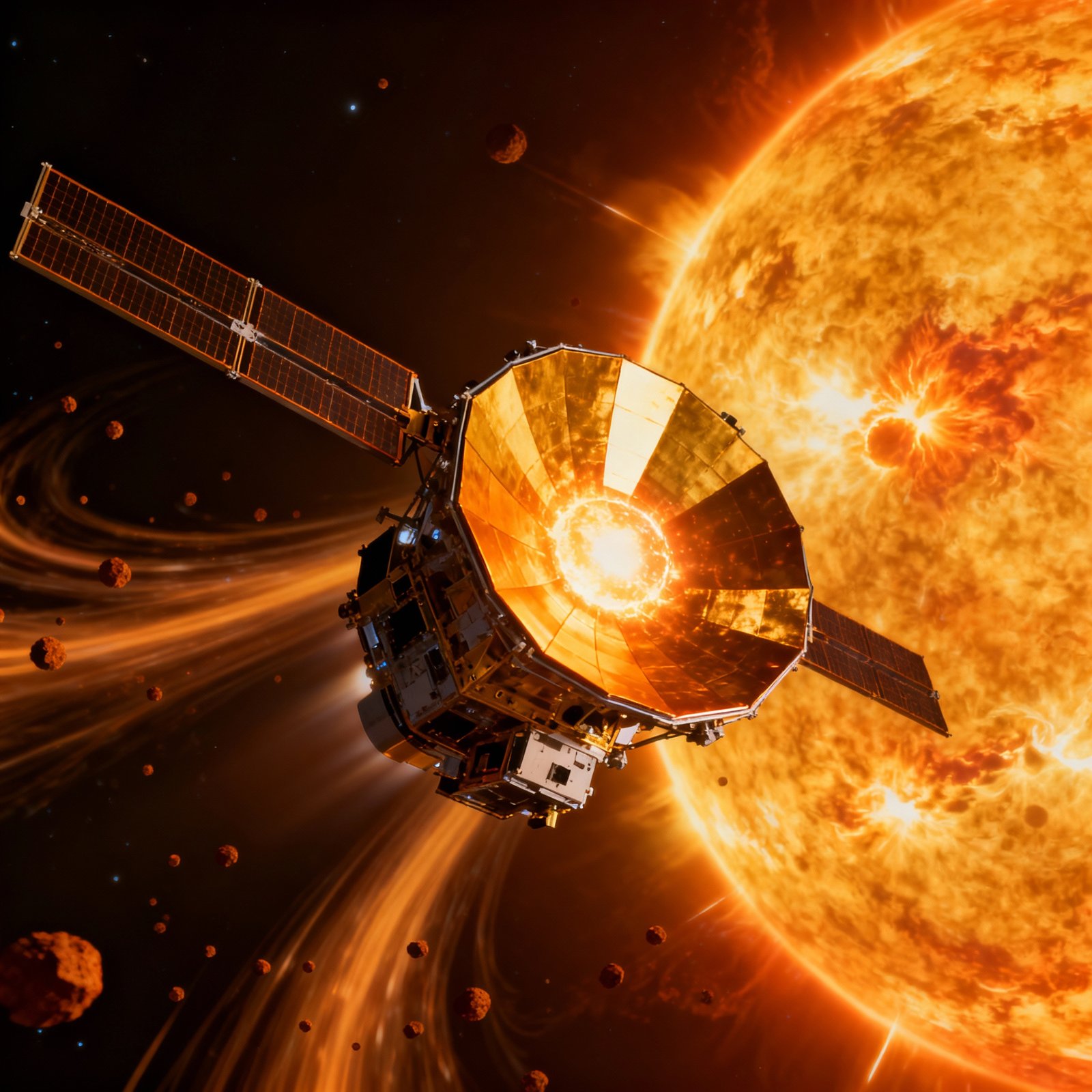
NASA's Parker Solar Probe has achieved the unprecedented feat of flying through the Sun's corona, becoming the first spacecraft to 'touch' our nearest star. This historic accomplishment provides revolutionary insights into solar physics and space weather phenomena that directly affect Earth and space-based technology.
Launched in August 2018, Parker Solar Probe has been gradually spiraling closer to the Sun through a series of Venus gravity assists. The spacecraft's specially designed heat shield, capable of withstanding temperatures exceeding 1,377°C (2,500°F), enables it to operate within 7 million kilometers of the solar surface—closer than any previous mission.
Dr. Nicola Fox, Parker Solar Probe project scientist, describes the achievement: 'We're finally able to study the corona from within, providing direct measurements of the solar wind's birth and acceleration. These observations are revolutionizing our understanding of how stars work.'
The probe's instruments have revealed surprising details about the corona's structure and dynamics. Contrary to expectations, the corona exhibits switchback magnetic field structures—sudden reversals in the magnetic field direction that accelerate solar wind particles to incredible speeds. These switchbacks may be key to understanding how the corona maintains its extreme temperatures.
Parker's observations have also provided new insights into coronal mass ejections (CMEs) and their potential impacts on Earth. By studying these phenomena at their source, scientists can improve space weather prediction models, potentially preventing satellite damage and power grid disruptions caused by severe solar storms.
The mission has identified the source regions of the fastest solar wind streams, traced their acceleration mechanisms, and measured the corona's magnetic field structure with unprecedented precision. These measurements are crucial for understanding fundamental plasma physics processes that occur throughout the universe.
Recent findings include the discovery of dust-free zones near the Sun, unexpected magnetic field configurations, and evidence for multiple solar wind acceleration mechanisms. Each close encounter provides new data that challenges existing theories and refines our understanding of stellar physics.
Parker Solar Probe will continue approaching the Sun through 2025, eventually reaching within 6.2 million kilometers of the solar surface. Each orbit provides increasingly detailed measurements that will guide the development of future solar physics missions and improve our ability to predict and mitigate space weather effects on Earth.
The spacecraft's journey through the corona has revealed that the boundary between the solar atmosphere and the solar wind is not a smooth, uniform surface but rather a highly dynamic and structured region. This finding helps explain why the corona is hundreds of times hotter than the Sun's surface—a mystery that has puzzled solar physicists for decades.
The mission has also discovered that the solar wind is not uniform but consists of distinct structures and flows that originate from different regions of the Sun. Understanding these variations is crucial for predicting how solar wind will interact with Earth's magnetic field and affect our technological infrastructure.
Parker Solar Probe's achievements extend beyond scientific discovery to technological innovation. The spacecraft's heat shield, solar arrays, and autonomous navigation systems represent breakthroughs in engineering that will enable future missions to extreme environments throughout the solar system.
The data collected by Parker Solar Probe is being shared with the global scientific community, fostering collaboration and accelerating our understanding of our nearest star. These observations are being combined with data from other solar observatories to create a comprehensive picture of solar activity and its effects on the entire solar system.
As Parker Solar Probe continues its daring mission, each close approach to the Sun brings new discoveries that challenge our understanding of stellar physics. The spacecraft's journey through the corona represents humanity's first direct exploration of a star's atmosphere, opening a new frontier in space science and bringing us closer to understanding the fundamental processes that power our solar system and shape the space environment we inhabit.