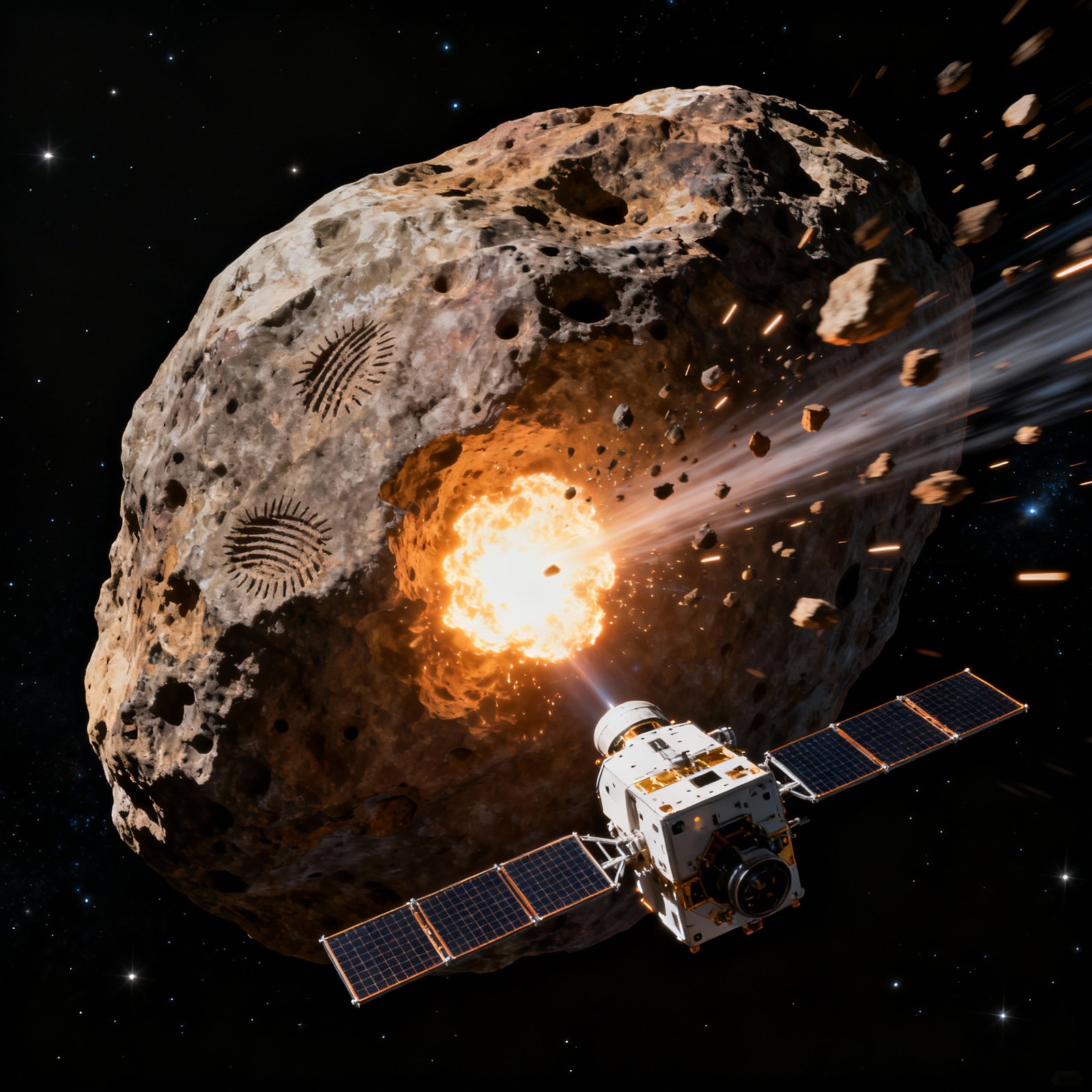
NASA's Double Asteroid Redirection Test (DART) mission has achieved a historic milestone in planetary defense, successfully demonstrating humanity's ability to alter the trajectory of a potentially hazardous asteroid. This groundbreaking mission represents our species' first attempt to deliberately change the motion of a celestial body and proves that we possess the technology to protect Earth from asteroid impacts.
On September 26, 2022, the DART spacecraft deliberately collided with Dimorphos, the smaller member of a binary asteroid system located 11 million kilometers from Earth. The impact successfully altered Dimorphos's orbital period around its larger companion, Didymos, by more than 30 minutes—far exceeding the mission's minimum success criteria of 73 seconds.
Post-impact observations using ground-based telescopes and space-based assets confirmed the mission's remarkable success. The impact created a spectacular debris cloud visible from Earth and demonstrated that the kinetic impactor technique can effectively redirect asteroids, validating computer models used for planetary defense planning.
Dr. Tom Statler, DART program scientist, explains: 'This mission shows that we are no longer powerless against cosmic impacts. We have proven that with sufficient warning time, we can deflect asteroids and protect our planet from catastrophic collisions.'
The success of DART has immediate implications for planetary defense strategies. The mission validates the kinetic impactor approach for small to medium-sized asteroids, while demonstrating the importance of precise trajectory planning and impact timing. International cooperation proved crucial, with contributions from multiple space agencies and research institutions.
ESA's upcoming Hera mission will visit the Didymos system in 2026 to conduct detailed post-impact surveys, measuring the crater created by DART and studying the altered dynamics of the binary system. This follow-up mission will provide crucial data for refining future planetary defense missions.
The mission's success has accelerated development of next-generation planetary defense systems, including larger kinetic impactors for more massive asteroids and gravity tractor spacecraft for precision trajectory modifications. These technologies, combined with improved asteroid detection systems, create a comprehensive planetary defense architecture.
DART's achievement represents more than technological success—it demonstrates international cooperation and forward-thinking investment in humanity's long-term survival, establishing precedents for protecting Earth from cosmic threats while advancing our capabilities for space exploration and resource utilization.
The mission also provided valuable scientific insights into asteroid composition and structure. The unexpected amount of debris ejected during the impact suggests that many asteroids may be loosely bound rubble piles rather than solid monolithic bodies. This information is crucial for designing future deflection missions, as the response to an impact depends heavily on the target's physical properties.
Public engagement with the DART mission was extraordinary, with millions watching the final approach and impact live. This enthusiasm for planetary defense demonstrates growing public awareness of asteroid risks and support for investments in protective technologies. Educational initiatives around the mission have inspired students to pursue careers in planetary science and engineering.
The success of DART has prompted discussions about establishing a permanent planetary defense program with regular testing and refinement of deflection technologies. Such a program could include multiple spacecraft designs for different asteroid sizes and compositions, along with an international framework for coordinated response to potential impact threats.
Looking ahead, the lessons learned from DART will inform the design of future missions to potentially hazardous asteroids. Each mission will build on the success of DART, gradually expanding our capabilities and reducing the risk of unexpected impacts. The technology developed for planetary defense may also have applications for asteroid mining and resource utilization in space.
As we continue to scan the skies for potentially hazardous objects, the success of DART provides reassurance that humanity is not helpless in the face of cosmic threats. While the probability of a major impact in our lifetime remains low, the consequences would be catastrophic. The DART mission represents a crucial investment in our collective security, demonstrating that with foresight, cooperation, and scientific innovation, we can protect our planet from the dangers that lurk in space.