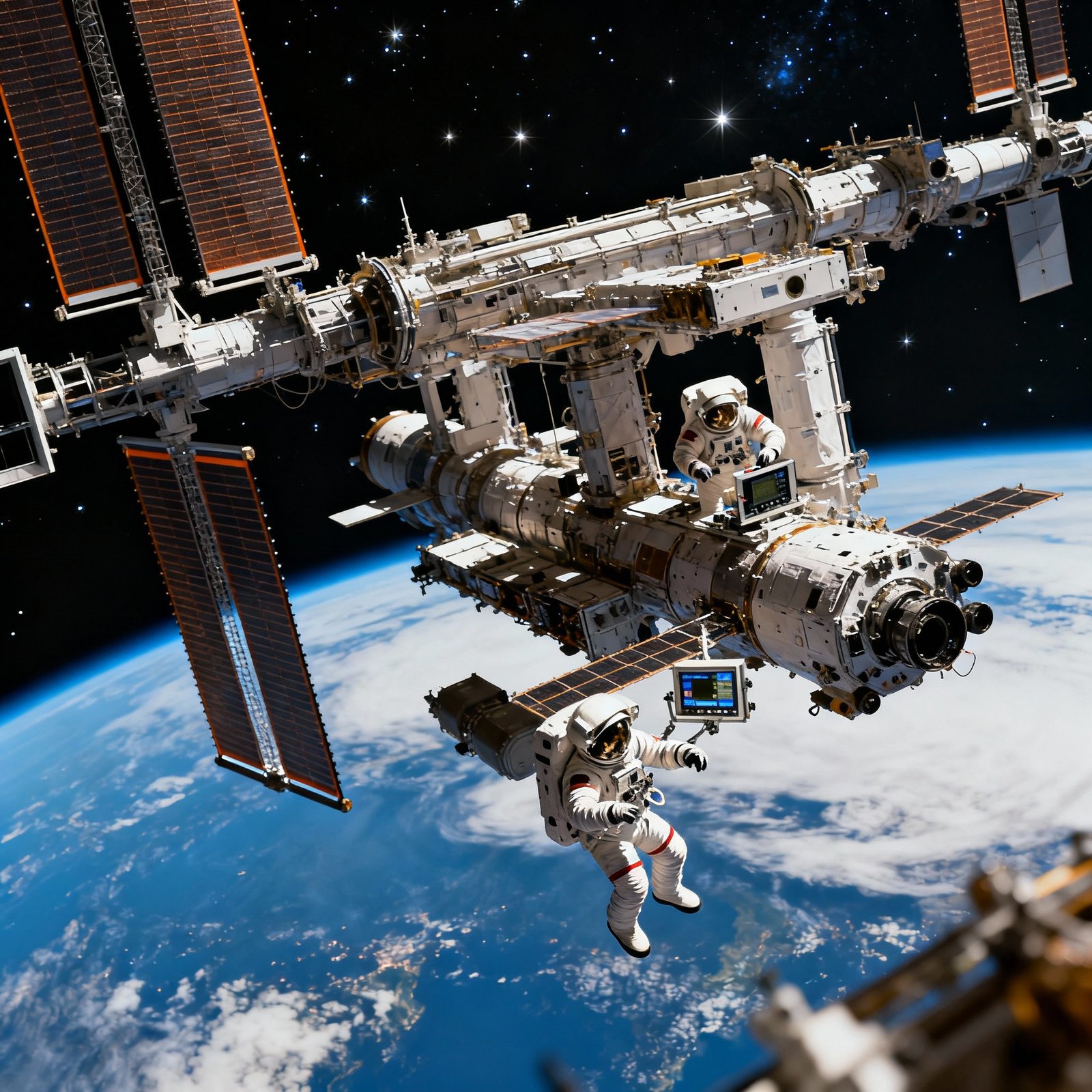
The International Space Station has completed over 20 years of continuous scientific research, establishing itself as humanity's premier laboratory for studying life and physical phenomena in microgravity. This remarkable achievement represents the longest-running human presence in space and has produced discoveries that benefit life on Earth while advancing our understanding of fundamental physics and biology.
Microgravity research aboard the ISS has revolutionized our understanding of protein crystallization, leading to improved drug development and therapeutic treatments. Experiments in the unique weightless environment have produced larger, more perfect protein crystals than possible on Earth, enabling researchers to determine molecular structures crucial for pharmaceutical development.
Dr. [Name], ISS Research Program Manager, emphasizes the station's impact: 'The microgravity environment allows us to study fundamental processes without the confounding effects of gravity. We've gained insights into fluid physics, combustion, and biological systems that would be impossible to achieve on Earth.'
Cardiovascular research has yielded particularly significant results, as astronauts experience physiological changes similar to accelerated aging. Studies of bone density loss, muscle atrophy, and cardiovascular deconditioning in microgravity provide insights into age-related health issues affecting millions of people on Earth.
Materials science experiments have produced advanced alloys and manufacturing techniques with applications in aerospace, automotive, and electronics industries. The ability to process materials without gravitational effects has led to stronger, lighter materials with unique properties impossible to achieve in terrestrial manufacturing.
Recent breakthrough experiments include the Cold Atom Lab, which has produced the first dual-species Bose-Einstein Condensates in space and demonstrated ultra-cool quantum sensors for the first time in the space environment. These quantum experiments open new possibilities for fundamental physics research and potential applications in precision navigation and sensing.
The station has also served as a testbed for technologies essential to future deep space exploration. Life support systems, closed-loop resource recycling, and long-duration human factors research directly support NASA's Artemis program and eventual Mars missions.
Commercial partnerships have expanded the station's research capabilities, with private companies conducting proprietary experiments while contributing to the broader scientific understanding. This model paves the way for future commercial space stations and sustained research presence in low Earth orbit.
Earth observation from the ISS provides unique perspectives on our planet, with astronauts capturing millions of images of changing landscapes, weather patterns, and human impacts on the environment. These observations contribute to climate research, disaster response, and resource management.
Educational outreach programs have inspired millions of students worldwide, with experiments designed by students being conducted aboard the station and live educational broadcasts connecting classrooms with astronauts. These efforts help build the next generation of scientists, engineers, and explorers.
The international nature of the ISS project has demonstrated unprecedented cooperation in space exploration, with astronauts from 19 countries living and working together in harmony. This collaboration serves as a model for future international space missions, including potential lunar bases and Mars expeditions.
As the ISS continues its scientific mission, it faces new challenges including aging systems and the emergence of commercial space stations. NASA and international partners are planning for the station's eventual retirement while ensuring continuity of research and the transition to new platforms.
The legacy of the International Space Station extends far beyond its scientific achievements. It has proven that humans can live and work productively in space for extended periods, established frameworks for international cooperation in space exploration, and inspired millions to look toward the stars. As we celebrate two decades of continuous occupation, the ISS stands as a testament to what humanity can achieve when we work together to push the boundaries of knowledge and exploration.