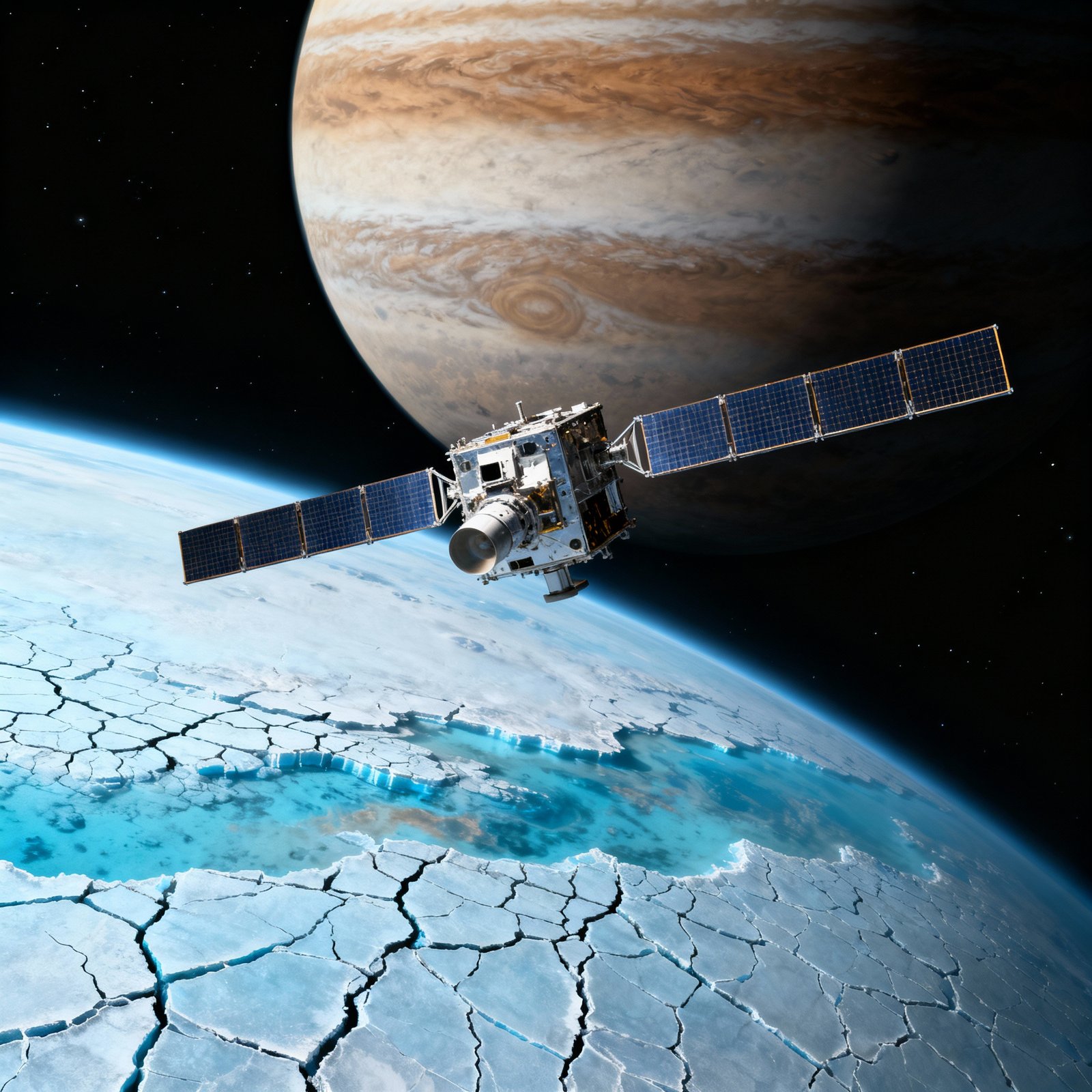
NASA's Europa Clipper mission, launched in October 2024, represents one of the most ambitious planetary science endeavors ever undertaken. This sophisticated spacecraft is journeying to Jupiter's ice-covered moon Europa, where a vast subsurface ocean may harbor conditions suitable for life. The mission promises to revolutionize our understanding of potentially habitable worlds beyond Earth.
Europa, one of Jupiter's four Galilean moons, has long captivated scientists with its smooth, ice-covered surface and strong evidence for a liquid ocean beneath. This subsurface ocean, containing more than twice the water in all Earth's oceans combined, remains in liquid state due to tidal heating from Jupiter's powerful gravitational field.
The Europa Clipper spacecraft carries nine sophisticated scientific instruments designed to study the moon's ice shell, subsurface ocean, composition, and geology during multiple close flybys. Rather than orbiting Europa directly, the spacecraft will orbit Jupiter and conduct 49 close encounters with the moon, avoiding the intense radiation environment that would quickly damage the instruments.
Dr. Robert Pappalardo, Europa Clipper project scientist, explains: 'We're not looking for life directly, but rather assessing Europa's habitability by understanding its ocean, ice shell, and geological processes. These measurements will determine whether Europa has the ingredients necessary for life as we know it.'
The mission's scientific objectives include mapping Europa's surface composition, measuring the thickness of its ice shell, confirming the existence and characteristics of the subsurface ocean, and identifying potential subsurface plume activity. Advanced radar instruments will penetrate the ice to reveal the ocean's depth and structure.
Europa Clipper's journey to Jupiter will take approximately six years, utilizing gravitational assists from Mars and Earth to reach its destination. Upon arrival in 2030, the spacecraft will spend four years conducting detailed reconnaissance of Europa's mysterious environment.
The mission represents a crucial step toward future astrobiology missions that might directly search for signs of life in Europa's ocean. If Europa proves habitable, it would dramatically expand our understanding of where life might exist in the universe and guide the search for similar worlds around other stars.
International collaboration enhances the mission's scientific return, with contributions from European partners and coordination with ESA's JUICE mission, also studying Jupiter's icy moons. This cooperative approach maximizes scientific output while sharing the costs and risks of exploring the outer solar system.
The spacecraft's instruments include cameras, spectrometers, ice-penetrating radar, and a magnetometer that will work together to create a comprehensive picture of Europa. The suite of instruments is designed to answer fundamental questions about the moon's potential habitability while searching for evidence of current or past geological activity.
One of the most exciting aspects of the mission is the potential to observe active plumes of water erupting from Europa's surface, similar to those discovered on Saturn's moon Enceladus. If such plumes exist, they could provide direct access to material from the subsurface ocean without the need for drilling through the ice shell.
The Europa Clipper mission builds on decades of scientific research and technological development, representing the culmination of efforts that began with the Voyager flybys in the 1970s and continued with the Galileo mission in the 1990s. Each previous mission has added to our understanding of Europa and increased the scientific case for a dedicated mission.
As Europa Clipper begins its long journey to Jupiter, it carries with it the hopes of scientists and the public alike for answers to one of humanity's most profound questions: Are we alone in the universe? The mission's findings will shape our understanding of habitability in our solar system and beyond, potentially revealing that the conditions for life may be more common than we ever imagined.