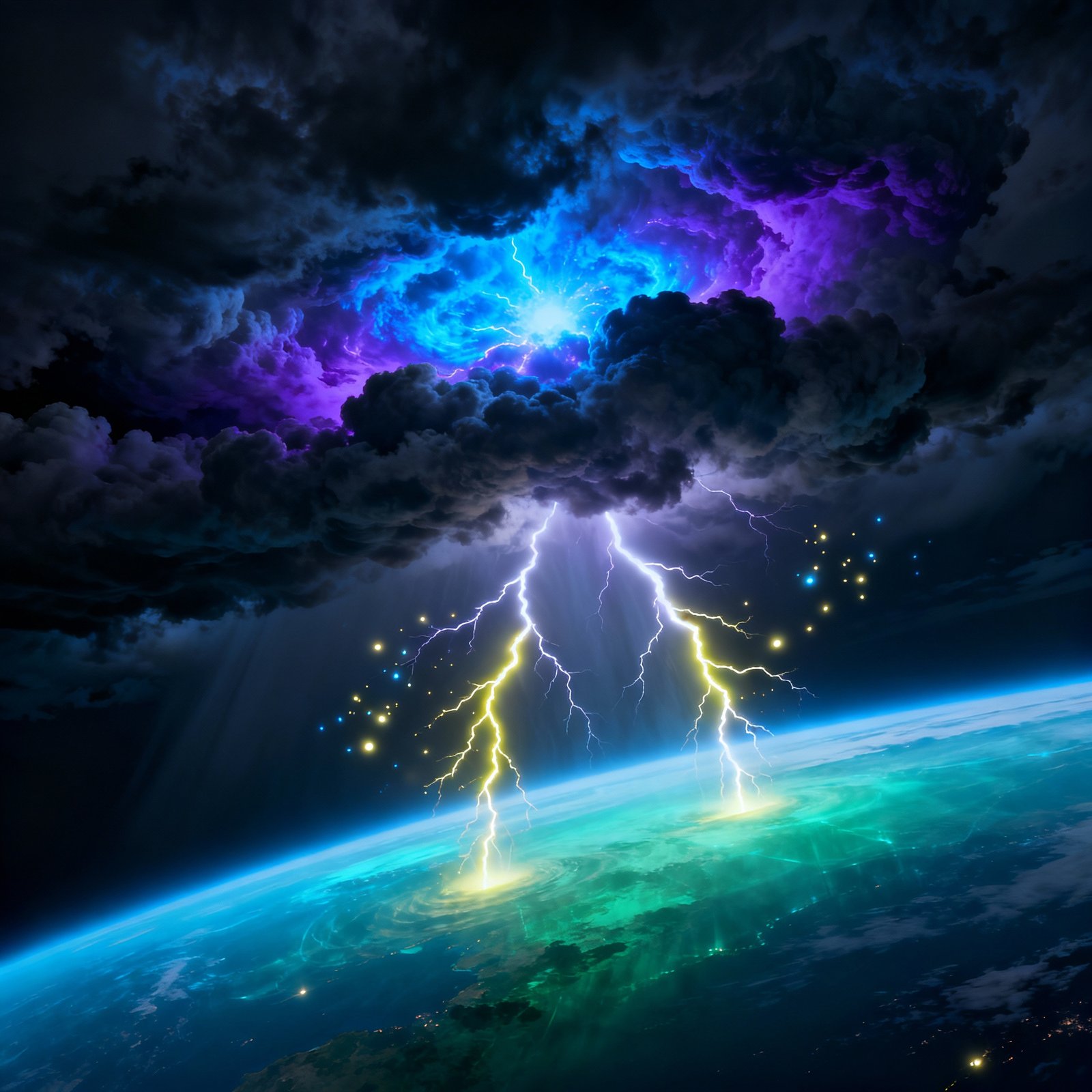
NASA's groundbreaking ALOFT (Airborne Lightning Observatory for FLy's Eye Geostationary Lightning Mapper Simulator and Terrestrial Gamma-Ray Flashes) campaign has uncovered a stunning revelation about Earth's atmosphere: thunderstorms routinely produce high-energy gamma radiation previously thought to be extremely rare. This discovery fundamentally changes our understanding of atmospheric electricity and its connection to space weather phenomena.
Using specialized instruments aboard NASA's high-altitude ER-2 aircraft, researchers detected gamma-ray glows that are far more common and persistent than previously imagined. These emissions, covering areas the size of entire thunderstorm complexes, can persist for hours and represent energy levels typically associated with cosmic phenomena rather than terrestrial weather.
'Originally thought to be up to 10,000 times rarer than lightning, terrestrial gamma-ray flashes (TGFs) were detected on most ALOFT science flights,' explains the research team. This dramatic revision suggests that high-energy atmospheric processes are fundamental features of severe weather systems rather than exotic anomalies.
The campaign also identified a completely new phenomenon: Flickering Gamma-ray Flashes (FGFs), which may represent the missing link between long-duration gamma-ray glows and conventional TGFs. This discovery resolves a decades-old puzzle in atmospheric electricity research and opens new avenues for understanding the complex energy processes within thunderstorms.
Dr. [Research Lead] from NASA's Goddard Space Flight Center emphasizes the implications: 'These findings suggest that thunderstorms are far more energetic and complex than we previously understood. The gamma radiation we're observing indicates electric fields strong enough to accelerate electrons to relativistic speeds within Earth's atmosphere.'
The research has profound implications for aviation safety, as commercial aircraft regularly fly through or near these high-energy environments. Understanding gamma-ray production in thunderstorms could improve weather prediction models and enhance flight safety protocols. Current aviation routing may need to be reconsidered in light of these findings, particularly for flights at high altitudes where gamma radiation exposure is more likely.
Beyond Earth-based applications, this research provides insights into similar processes occurring in other planetary atmospheres throughout the solar system. Jupiter's massive storms, for example, may produce even more intense gamma-ray emissions, offering new perspectives on atmospheric dynamics across different worlds. Future missions to gas giants may include specialized instruments to detect these high-energy phenomena.
The discovery also has implications for our understanding of Earth's radiation environment and its impact on the upper atmosphere. Gamma rays from thunderstorms may influence atmospheric chemistry, particularly in the stratosphere where they can affect ozone concentrations and other trace gases. This previously unrecognized source of high-energy radiation must be incorporated into atmospheric models to improve their accuracy.
Future missions will expand these observations using satellite-based instruments and ground-based gamma-ray detector networks, creating a comprehensive picture of high-energy atmospheric phenomena and their role in Earth's complex weather systems. The European Space Agency's ASIM mission and other dedicated instruments will continue monitoring these events from space, providing global coverage and long-term data collection.
The ALOFT campaign demonstrates how airborne science platforms can provide unique perspectives on atmospheric phenomena that are difficult to study from the ground or space. By flying through and above thunderstorms, researchers can directly measure the electric fields and radiation levels within these powerful weather systems, gathering data that would be impossible to obtain otherwise.
As our understanding of these high-energy atmospheric processes grows, we may need to revise our fundamental concepts of how thunderstorms work and how they interact with the broader Earth system. The discovery that our own atmosphere routinely produces gamma radiation blurs the boundary between terrestrial weather and space physics, revealing connections that span from the surface of our planet to the edges of space.