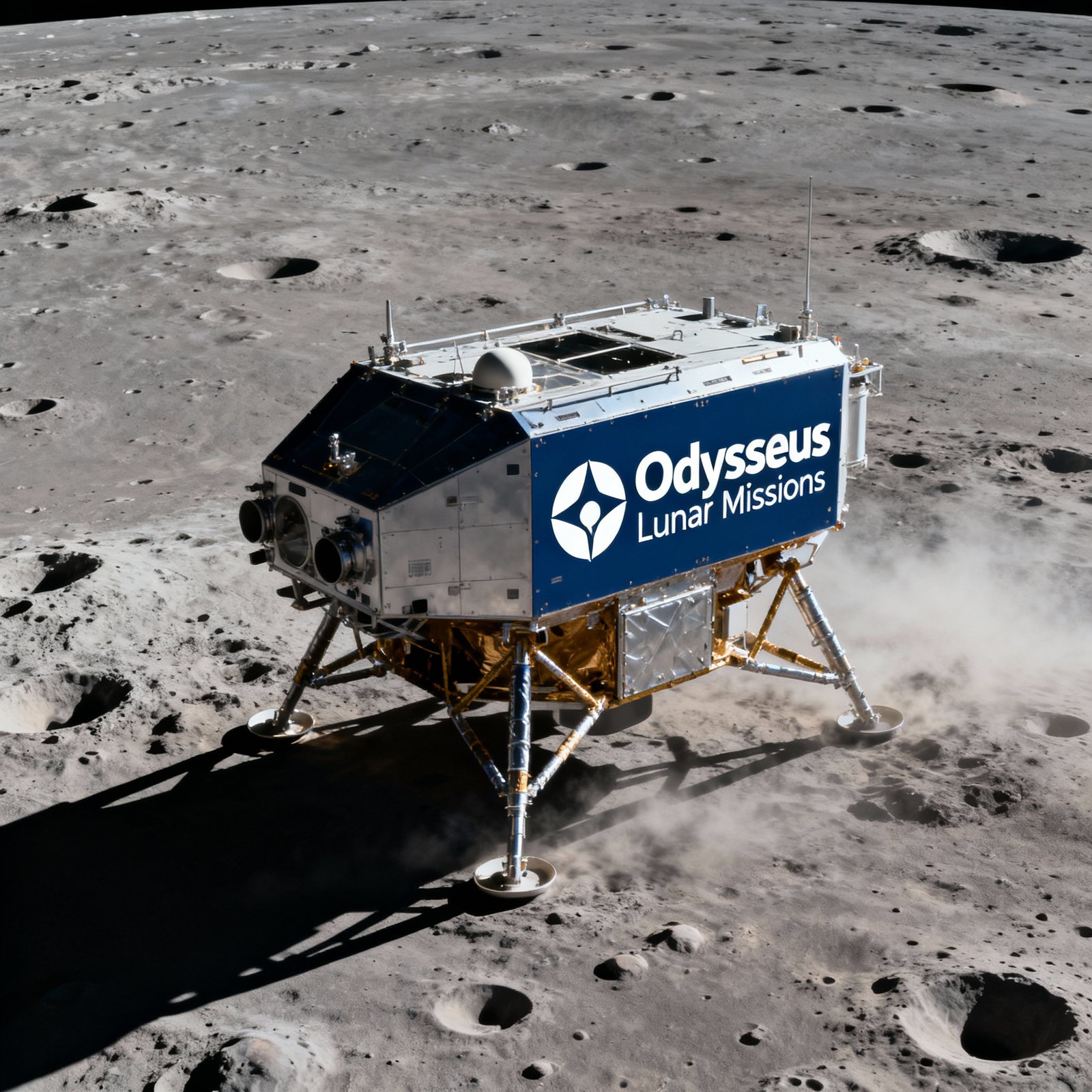
Intuitive Machines achieved a historic milestone in February 2024 when their Odysseus lunar lander became the first privately-built spacecraft to successfully land on the Moon. This achievement marks a transformative moment for the commercial space industry and NASA's strategy for lunar exploration through public-private partnerships.
The IM-1 mission, part of NASA's Commercial Lunar Payload Services (CLPS) program, demonstrated the viability of cost-effective lunar missions using commercially developed spacecraft. Odysseus carried six NASA payloads designed to test technologies and collect data essential for the Artemis program's human return to the Moon.
Despite encountering last-minute navigation challenges that required innovative problem-solving, the mission team successfully landed Odysseus near the Moon's south pole—a region of high scientific and strategic interest due to potential water ice deposits. This achievement validated the commercial approach to lunar exploration while providing valuable lessons for future missions.
Joe Cassidy, Intuitive Machines' CEO, emphasized the significance: 'This mission proves that private industry can deliver reliable, cost-effective lunar access while advancing scientific knowledge. We're opening the Moon to a new generation of exploration and commerce.'
The mission carried diverse scientific instruments, including a radio astronomy payload that will study the early universe without interference from Earth's atmosphere, precision landing technology demonstrations, and resource prospecting instruments. Data from these payloads directly supports NASA's lunar exploration objectives.
Odysseus's success has accelerated commercial lunar development, with multiple companies now preparing follow-up missions. This competitive environment drives innovation while reducing costs, making lunar access more routine and sustainable than government-only programs.
The CLPS program represents a fundamental shift in NASA's approach to space exploration, leveraging commercial capabilities to achieve scientific objectives while focusing agency resources on deep space exploration technologies and human spaceflight systems.
Future commercial lunar missions will deliver increasingly sophisticated payloads, including rovers, sample return systems, and infrastructure components for sustained lunar operations. This commercial foundation supports NASA's long-term goals of establishing a permanent human presence on the Moon while creating new economic opportunities in the emerging lunar economy.
The success of IM-1 demonstrates that the age of routine, commercial lunar access has begun, paving the way for scientific discoveries, resource utilization, and eventual human settlement beyond Earth. This achievement represents the culmination of decades of investment in commercial space capabilities and the beginning of a new era in lunar exploration.
Beyond NASA's needs, commercial lunar missions are opening opportunities for international partners, academic institutions, and private companies to conduct lunar research and exploration. This democratization of access to the Moon could accelerate scientific discovery and technological innovation in ways that were impossible when only governments could reach the lunar surface.
The technical challenges overcome during the Odysseus mission—including navigation issues, communication delays, and the harsh lunar environment—provide valuable experience for future commercial lunar endeavors. Each mission builds on the lessons learned from previous attempts, gradually increasing reliability and capability.
As the commercial lunar sector matures, we can expect to see the development of lunar habitats, resource extraction facilities, and eventually infrastructure that supports human presence on the Moon. The success of Odysseus represents the first step in this ambitious journey, demonstrating that private companies can play a crucial role in expanding humanity's presence beyond Earth.
The implications of this achievement extend far beyond lunar exploration. The proven model of public-private partnership demonstrated by the CLPS program could transform how we explore the entire solar system, with commercial companies providing transportation services while government agencies focus on cutting-edge research and human exploration. This approach could dramatically accelerate our expansion into space while reducing costs and increasing sustainability.