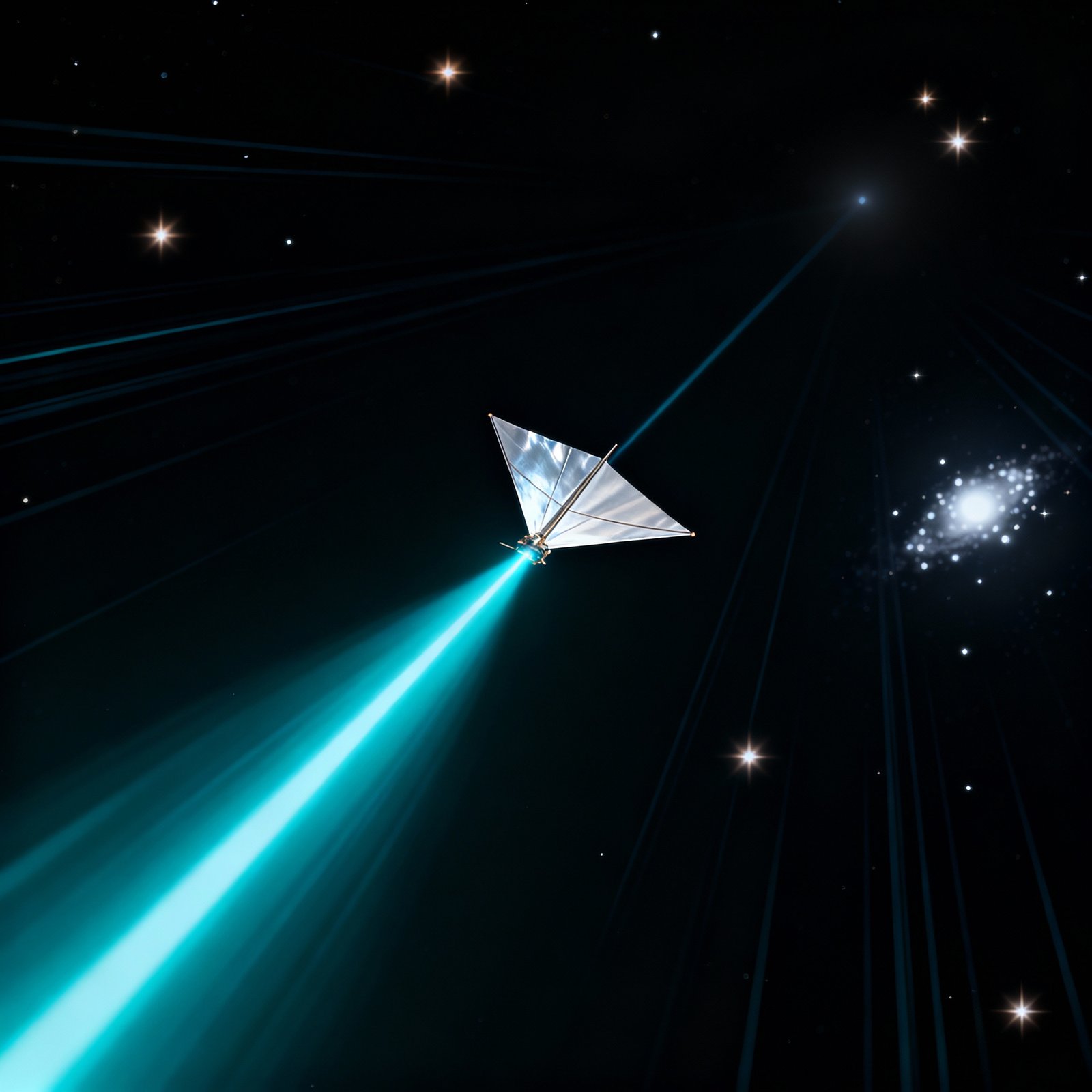
The Breakthrough Starshot initiative represents humanity's most ambitious attempt to reach another star system, proposing to send tiny spacecraft to Alpha Centauri at 20% the speed of light using revolutionary light sail technology. This groundbreaking project, backed by visionaries including Stephen Hawking and Mark Zuckerberg, could achieve interstellar travel within human lifetimes.
The concept centers on ultra-lightweight spacecraft called StarChips, each weighing just one gram and equipped with cameras, sensors, and communication equipment. These miniature probes would be accelerated by powerful Earth-based laser arrays, reaching speeds of 60,000 kilometers per second—fast enough to reach Alpha Centauri in approximately 20 years.
Dr. Pete Worden, Executive Director of Breakthrough Starshot, explains the revolutionary approach: 'By using light pressure rather than chemical propulsion, we can achieve speeds impossible with conventional spacecraft. This technology could provide our first glimpse of planets around other stars within this century.'
The technical challenges are formidable. The laser array must generate power equivalent to a large nuclear power plant, focused with precision across interstellar distances. The StarChips must survive acceleration forces millions of times greater than Earth's gravity, cosmic radiation exposure, and micrometeorite impacts during their decades-long journey.
Recent technological advances in miniaturization, materials science, and laser technology have made the concept increasingly feasible. Silicon photonics enables sophisticated instruments to be manufactured at microscopic scales, while metamaterials provide ultra-lightweight yet durable structural components.
The scientific potential is extraordinary. StarChip swarms could photograph Proxima Centauri b, a potentially Earth-like planet in Alpha Centauri's habitable zone, providing humanity's first close-up images of an exoplanet. Detailed measurements of the interstellar medium, magnetic fields, and cosmic ray environment would revolutionize our understanding of the space between stars.
Beyond Alpha Centauri, the technology could enable missions to hundreds of nearby star systems, creating a comprehensive survey of our galactic neighborhood and potentially discovering signs of life beyond Earth. Each mission would provide crucial data for understanding planetary formation, stellar evolution, and the distribution of habitable worlds.
While still in early development phases, Breakthrough Starshot represents a paradigm shift in space exploration—demonstrating that interstellar travel, long relegated to science fiction, may become reality within decades through innovative engineering and international cooperation in pursuit of humanity's greatest adventure.
The initiative has already spurred advances in multiple fields, including laser technology, materials science, and miniaturized electronics. Even if the full interstellar mission takes decades to realize, these technological spinoffs could benefit numerous other applications on Earth and in space.
International collaboration is essential for the project's success, with scientists and engineers from around the world contributing expertise and resources. The Breakthrough Initiatives organization has established partnerships with leading research institutions and space agencies to tackle the technical challenges.
Recent prototype tests have demonstrated key components of the system, including successful deployment of light sail materials and precision laser pointing over long distances. These incremental achievements bring the ambitious goal of interstellar travel closer to reality.
The Breakthrough Starshot concept also raises important philosophical questions about humanity's place in the universe and our responsibility as we potentially become an interstellar species. The initiative includes careful consideration of planetary protection protocols to ensure that our explorations do not contaminate potentially habitable worlds.
As we look to the future of space exploration, Breakthrough Starshot represents the most ambitious vision yet conceived—a journey to the stars that could begin within our lifetime. While the challenges remain significant, the potential rewards—scientific knowledge, inspiration for future generations, and perhaps answers to the question of whether we are alone in the universe—make this bold endeavor worthy of our greatest efforts and aspirations.