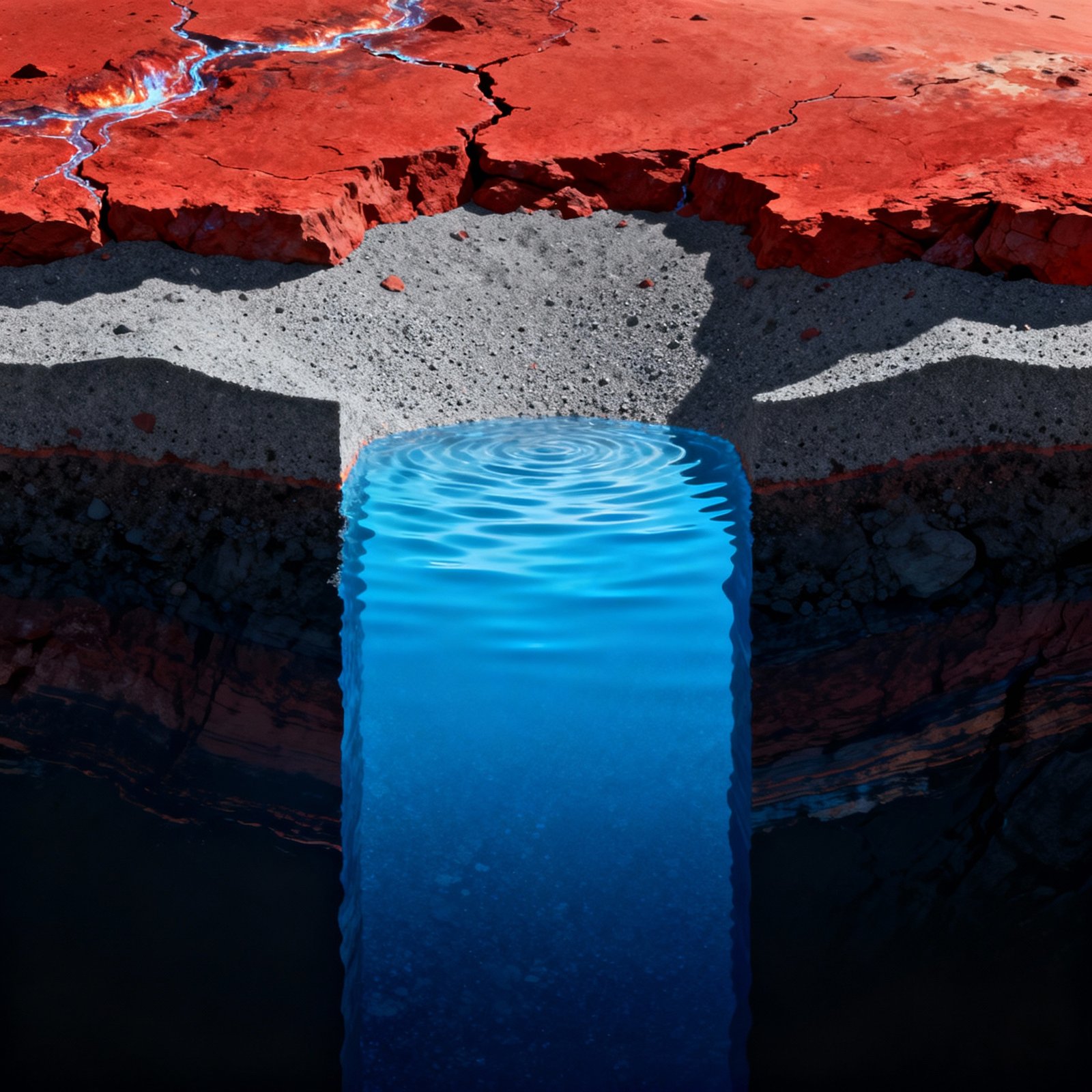
In a groundbreaking discovery that reshapes our understanding of the Red Planet, scientists analyzing data from NASA's InSight lander have confirmed the existence of vast liquid water reservoirs buried deep beneath Mars' surface. The findings, published in the Proceedings of the National Academy of Sciences, suggest that enough water exists underground to cover the entire planet in an ocean 1 to 2 kilometers deep.
Using seismic data collected over four years, researchers detected vibrations from Martian quakes that revealed the presence of liquid water 11.5 to 20 kilometers beneath the surface. Dr. Vashan Wright from UC San Diego, who led the study, explains that understanding the Martian water cycle is critical for comprehending the planet's climate evolution and potential for past or present life.
The discovery addresses one of Mars' greatest mysteries: where did all the ancient water go? Billions of years ago, Mars had rivers, lakes, and possibly oceans on its surface. While some water escaped to space when Mars lost its atmosphere, scientists have long suspected that significant amounts went underground. This new research provides the first definitive evidence of liquid water reservoirs rather than just ice deposits.
'This is the first time we've found evidence of a big reservoir of liquid water,' said Professor Michael Manga from UC Berkeley. 'If habitable conditions exist on Mars, they might currently be found deep underground.' However, accessing this water presents enormous challenges, as it lies deeper than any current drilling technology could reach. The deepest wells drilled on Earth extend only about 12 kilometers, and Mars presents additional engineering challenges with its lower gravity, extreme temperatures, and lack of infrastructure.
The implications for astrobiology are profound. Liquid water is essential for life as we know it, and these protected underground environments could potentially harbor Martian microorganisms that survived the planet's surface becoming inhospitable. The deep water reservoirs would be shielded from harmful solar radiation and maintain relatively stable temperatures, potentially creating habitable niches that have persisted for billions of years.
Future Mars missions will likely focus on finding shallower water deposits or developing advanced drilling technologies to access these deep reserves. The discovery also has significant implications for future human colonization of Mars, as water is essential for drinking, agriculture, and producing rocket fuel for return journeys to Earth. While the deep reservoirs remain inaccessible for now, they suggest that water resources on Mars may be more abundant than previously thought.
This discovery also provides valuable insights into planetary evolution and the potential for water on other rocky planets throughout our galaxy. Understanding how Mars lost its surface water but retained it underground helps scientists model the water cycles on exoplanets and assess their potential habitability. The research demonstrates that even planets that appear arid on the surface may harbor significant water resources beneath their crusts.
As NASA and other space agencies plan future Mars missions, this discovery will influence exploration strategies and target selection. Regions above these deep water reservoirs may show geological features or mineral signatures that could help identify more accessible water deposits. The search for present or past life on Mars will also be informed by this finding, as underground environments protected from harsh surface conditions become priority targets for future astrobiology missions.