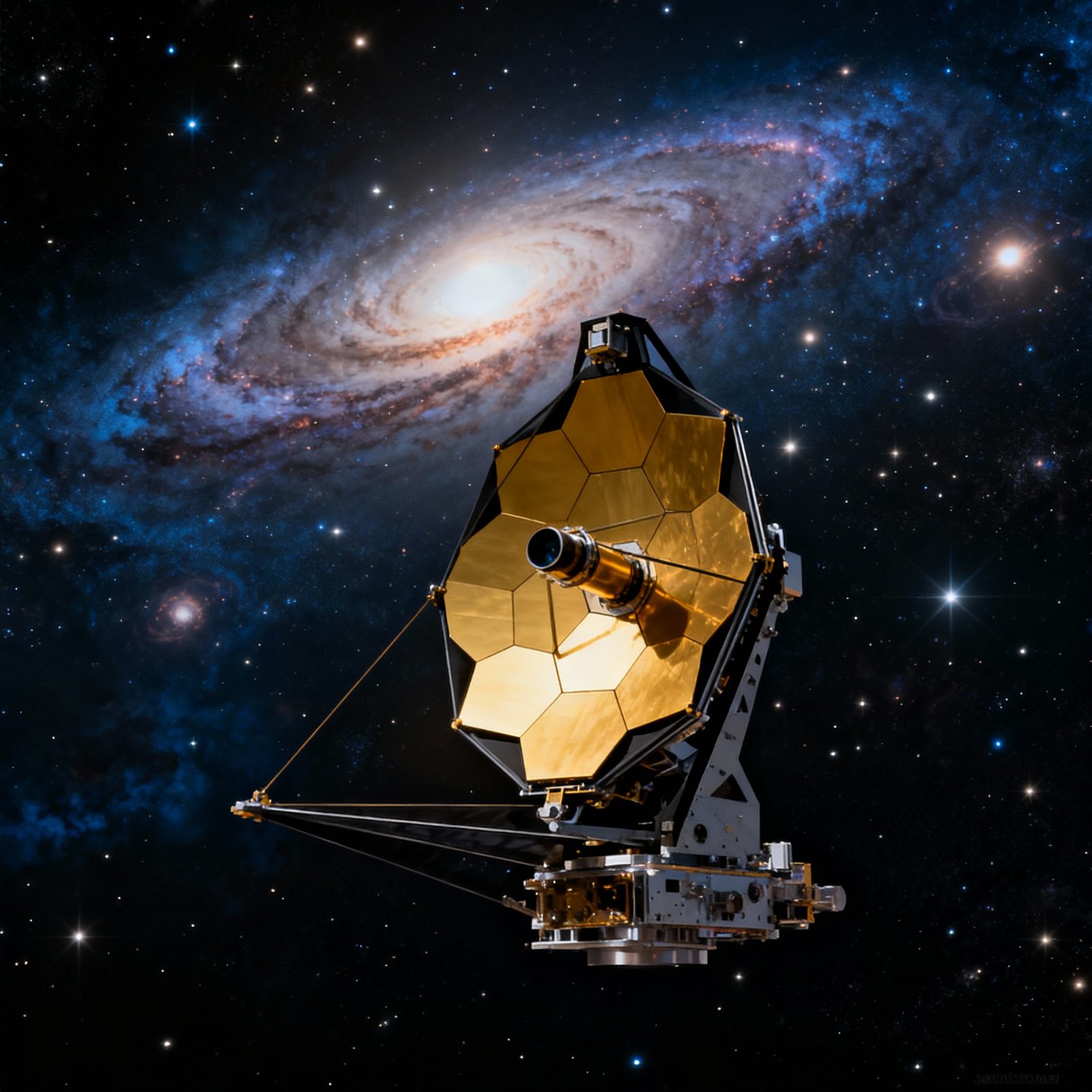
The James Webb Space Telescope continues to revolutionize our understanding of the early universe with its latest observations of galaxies that existed less than a billion years after the Big Bang. These discoveries challenge fundamental assumptions about how quickly cosmic structures could form in the universe's infancy, forcing astronomers to reconsider their models of galaxy formation and evolution.
Initially, astronomers were puzzled by galaxies that appeared impossibly massive for their age, leading to concerns about our understanding of cosmic evolution. However, recent analysis published in The Astronomical Journal has revealed that these galaxies achieve their remarkable brightness not through unprecedented mass, but through the activity of supermassive black holes at their centers.
Dr. Steven Finkelstein from the University of Texas at Austin, co-author of the study, confirms: 'There is no crisis in terms of the standard model of cosmology. These galaxies have normal masses but are getting a brightness boost from accretion disks around their central black holes.' The team used JWST's unprecedented infrared capabilities to detect the signature of hot, fast-moving gas characteristic of black hole accretion.
However, the mystery deepens as astronomers are still observing roughly twice as many galaxies as predicted for this early epoch. This suggests that early star formation may have been more efficient than previously thought, allowing galaxies to assemble more rapidly than current models predict. The implications are profound, potentially requiring revisions to our understanding of how the first stars and galaxies formed after the cosmic dark ages.
The telescope's ability to peer back 13.5 billion years has also revealed other remarkable phenomena, including supermassive black holes that formed much earlier than expected and complex organic molecules in primordial galaxies. These carbon-based compounds, similar to those found in Earth's oil and coal deposits, were detected from over 12 billion years ago when the universe was just 10% of its current age.
Dr. Justin Spilker from Texas A&M University notes that 'Webb really makes looking for organic molecules look too easy.' This capability opens new avenues for understanding how the building blocks of life formed in the early universe and potentially seeded the formation of habitable worlds throughout cosmic history. The detection of complex organic molecules in the early universe suggests that the chemical ingredients for life may have been widespread much earlier than previously believed.
The James Webb Space Telescope's observations are also providing insights into the reionization epoch, when the first stars and galaxies transformed the universe from opaque to transparent. By studying the light from these early galaxies, astronomers can map how this process unfolded across cosmic time, revealing when and how the universe became transparent to ultraviolet light.
These discoveries have significant implications for future telescope missions and observational strategies. The success of JWST in detecting and characterizing these early objects demonstrates the value of infrared astronomy for studying the distant universe. Future missions may build on this success with even larger mirrors and more sensitive instruments, potentially pushing our observational horizon closer to the very first stars that formed after the Big Bang.
As astronomers continue to analyze the wealth of data from JWST, they expect to uncover even more surprises about the early universe. Each new observation challenges our understanding and pushes the boundaries of what we thought possible in the cosmos. The telescope's discoveries are not just expanding our knowledge of the distant past but also informing our understanding of how galaxies like our own Milky Way evolved over billions of years.