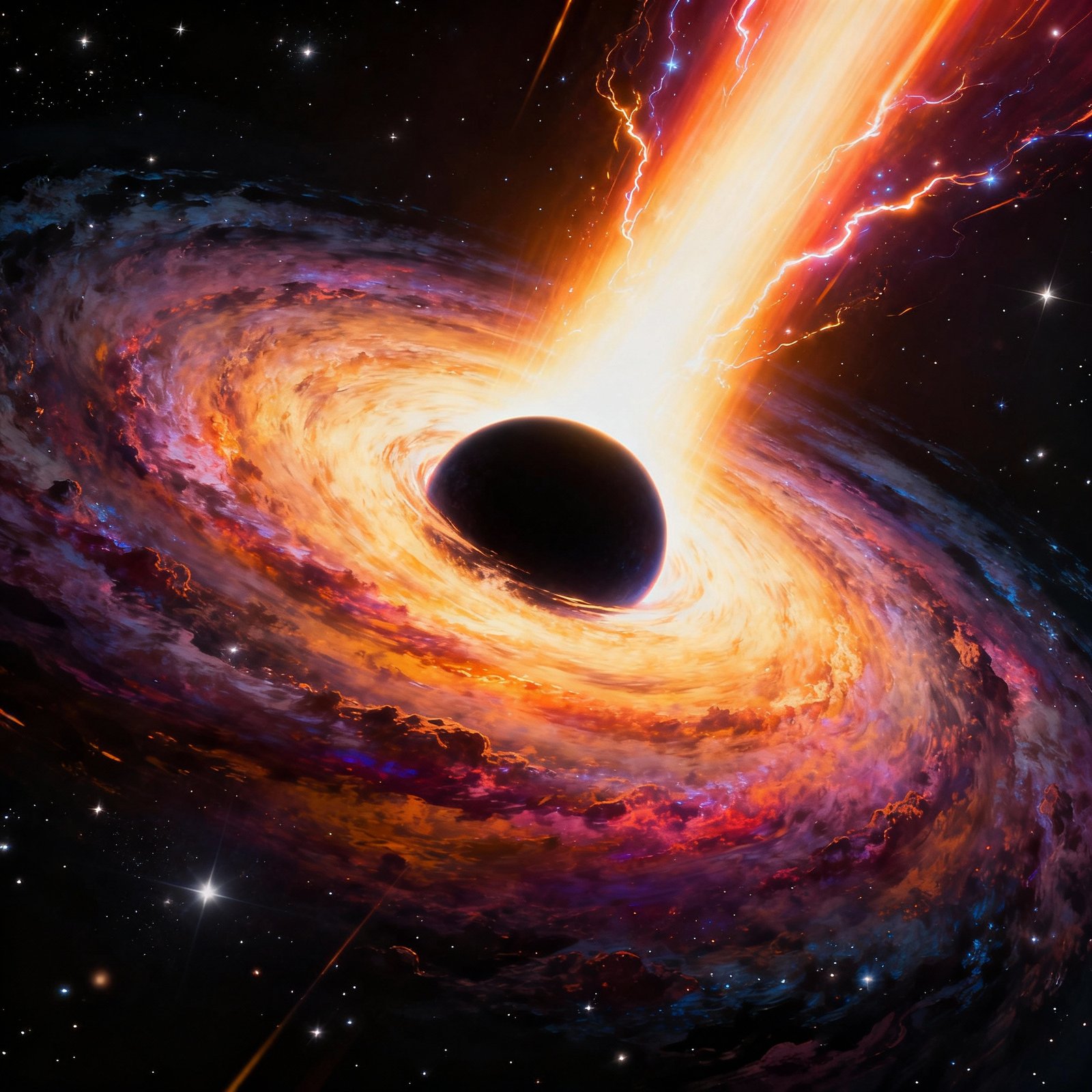
Astronomers using the James Webb Space Telescope have discovered a supermassive black hole that appears to be violating fundamental physics by consuming matter at a rate 40 times beyond what was thought theoretically possible. The black hole, designated LID-568, is having what researchers describe as an unprecedented cosmic 'feast' that challenges our understanding of these extreme cosmic objects.
The discovery challenges the Eddington limit, a fundamental principle that describes the maximum rate at which a black hole can accrete matter while maintaining equilibrium between its inward gravitational pull and the outward pressure from heated, compressed matter. When matter falls into a black hole faster than this limit, the resulting pressure should theoretically halt further accretion.
'This black hole is having a feast,' explains Dr. Julia Scharwächter from the International Gemini Observatory. 'This extreme case shows that a fast-feeding mechanism above the Eddington limit is one of the possible explanations for why we see these very heavy black holes so early in the Universe.' The observation suggests that our theoretical understanding of black hole physics may be incomplete or that special conditions allow some black holes to exceed the Eddington limit.
The team's observations revealed powerful outflows of gas around the central black hole, moving at extraordinary speeds across vast distances. These observations suggest that a substantial fraction of LID-568's mass growth occurred during a single episode of rapid accretion, rather than the gradual feeding process typically observed in supermassive black holes.
Dr. Hyewon Suh, who led the research published in Nature Astronomy, describes the finding as serendipitous: 'This result added a new dimension to our understanding of the system and opened up exciting avenues for investigation.' The discovery was made possible by JWST's NIRSpec instrument, which provided an unprecedented view of the black hole and its surrounding environment.
This extreme feeding behavior may help explain one of astronomy's greatest puzzles: how supermassive black holes reaching billions of solar masses could form so early in the universe's history. Traditional models suggest these cosmic giants should take billions of years to grow, yet JWST has found them existing when the universe was less than a billion years old.
The implications extend beyond black hole physics, potentially revolutionizing our understanding of early galaxy formation and the co-evolution of galaxies and their central black holes throughout cosmic history. If supermassive black holes can grow rapidly through episodes of extreme feeding, this would accelerate galaxy formation processes and help explain the mature galaxies observed in the early universe.
Several theories have been proposed to explain how black holes might exceed the Eddington limit. One possibility is that the accretion disk around the black hole has an unusual geometry that allows radiation to escape more efficiently, reducing the outward pressure that would normally limit accretion. Another theory suggests that magnetic fields might channel matter directly into the black hole while allowing radiation to escape perpendicular to the disk.
The discovery of LID-568 and other similarly feeding black holes suggests that these extreme conditions might not be as rare as previously thought. Future observations with JWST and other advanced telescopes will search for additional examples, helping astronomers understand what conditions lead to such extreme feeding behavior and how it affects the evolution of both black holes and their host galaxies.
As our observational capabilities continue to improve, we can expect to find more objects that challenge our theoretical understanding. Each discovery pushes the boundaries of our knowledge and forces us to refine our models of how the universe works, demonstrating that nature often finds ways to exceed what we believe to be possible.